Presentation Biology Living habits Infestation Control methods
Home > Infestation > Attacks variability over the season (attack pattern)
Author: François DROUET.
Photographs: François DROUET.
All rights reserved.
Attacks variability over the season (attack pattern)
Below, personal observations (no information reported from the literature). Toulon region; French eastern Mediterranean coast; USDA zone 9b.
3-PHASE ATTACK PATTERN
I observe a variability of the Black Fig Fly attacks over the season, responding to a general attack pattern which shows the existence of 3 phases.
Phase 1: intense attacks concentrated on a short duration. For a given fig tree, this phase concentrates 75 % to 97 % of the ovipositions of the season, and lasts from 2 to 3 weeks, depending on the variety and the tree location. Knowing that its intensity (ovipositions percentage) is not proportional to its duration.
Phase 2: very low attacks level. During this phase the number of attacks is always significantly lower than the number of unripe figs of the size required for the attack that are present on the tree. And there is a regular presence of feeding black fig flies on it.
Phase 3: total absence of attacks. Being emphasized that during this phase, immature figs with the size required for the attack of the Black Fig Fly are still on the fig tree, and there is a regular presence of feeding black fig flies on it.
Note: I am sure of my observations in my orchard relative to the variability of the attacks over the season. But I am not sure that they are unviversal in scope. I suggest to check in other regions if there is a variability of the attacks over the season, and if yes, if it is more or
less in accordance with the exposed attack pattern. This remark particularly applies to commercial orchards, for which I have no observations in my region for a possible variability of the attacks.
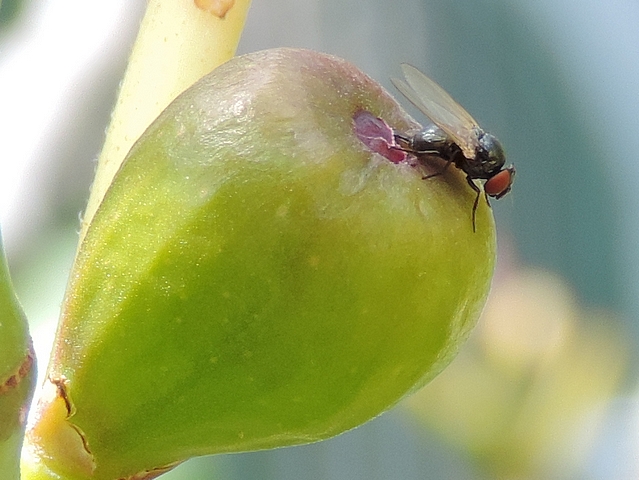
Black Fig Fly female laying eggs under an ostiolar scale of an unripe fig.
ATTACK PATTERN VARIATIONS
The general attak pattern of the Black Fig Fly may apply with some differences from one fig tree to another. The differences exist for the 3 phases, and depend on the fig variety and, for the biferous varieties, on the nature of the crop (breba crop or second crop). They relate to the duration and the intensity level for the phase 1, and to the duration for the phases 2 and 3. Below, some examples, for the year 2019 in my orchard.
For the phase 1: 'Bellone' variety 90 % of the attacks / 12 days; 'Col de Dame Noire' 97% of the attacks / 23 days; 'Grise de la Saint-Jean', breba crop 75 % of the attacks / 17 days, 'Grise de la Saint-Jean', second crop 88 % of the attacks / 20 days.
For the phase 2: duration 3 to 5 weeks for 'Bellone', 'Col de Dame Noire' and 'Grise de la Saint-Jean' (second crop), 2.5 months for 'Grise de la Saint-Jean' (breba crop).
For the phase 3: duration of 3 to 6 weeks for 'Bellone', 'Col de Dame Noire' and 'Grise de la Saint-Jean' (second crop), 8 days for 'Grise de la Saint-Jean' (breba crop).
Notes: the severity of the season attacks depends on the percentage of affected figs - related to the global crop - during the phase 1. Not on the percentage of the attacks of the year during this phase. The level of the attacks in an orchard is the conjunction of four factors: the orchard location in the region affected by the Black Fig Fly, the figs varieties susceptibility to the Black Fig Fly, the orchard management (density, fig trees shape, pruning), and the specific activity level of the Black Fig Fly for the considered year.
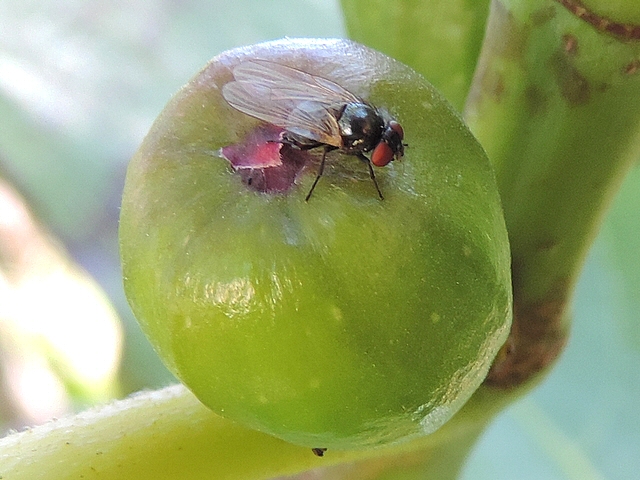
Black Fig Fly female laying eggs under an ostiolar scale of an unripe fig.
UNIQUENESS OF THE INTENSE ATTACKS PHASE IN THE YEAR
The Silba adipate McAlpine attack pattern reveals a major principle to take into consideration when combating this pest: for a given uniferous fig tree, there is only one intense attacks phase in the year, even though several successive generations of black fig flies may frequent it. The intense attacks phase is only associated with the first generation of the year (females coming from the ovipositions in the breba figs of biferous fig trees and from the profichi of caprifig trees), and not with each subsequent generation.
It should be noted that "for a given fig tree" is equivalent to "for a given orchard", the principle applying to each fig tree in the orchard. This is true even if the orchard is multi-varietal, because the variety can influence the time of the intense attacks phase within the season (which can differ from one variety to another), but not the number of occurrences of this phase, which remains equal to 1 for each fig tree, and therefore for each of the varieties comprising the orchard.
For biferous fig trees, the aforementioned principle applies to the second harvest, knowing that for these there is also a single intense attacks phase (females of the previous year last generation, which have emerged from their winter diapause).
Note: the characteristics of the intense attacks phase are covered in a separate chapter.
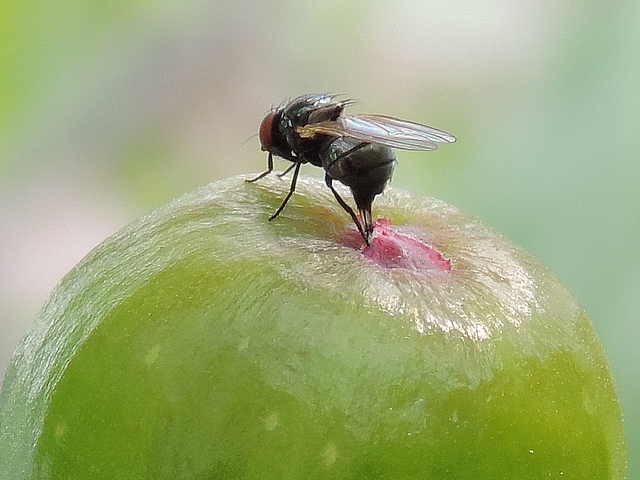
Black Fig Fly female laying eggs under an ostiolar scale of an unripe fig.
 Top of page Summary