COUPLE ARRIVAL ON THE FIG TREE
On August 21, 2026, while visiting the upper Aude Valley, I was testing latex baits for Silba adipata McAlpine on a century-old fig tree of undetermined variety. Around 3:00 PM, I clearly spotted, for a split second, two black fig flies mated in flight. They quickly landed on the edge of the upper side of a leaf located 1.70 m above the ground, on the north side of the tree.
The tree is a single-crop variety producing green fruit at maturity, trained as a bush and limited to a height of 4 m. It stands in a garden at an elevation of 550 m, alongside other fig trees growing in close proximity. I regularly observe Silba adipata McAlpine infestations at this site starting in late June. The temperature was 19°C, with a light wind that included sudden gusts, making photography difficult and compromising video quality.
The couple was not attracted to the deployed baits (latex exuded from the bases of torn-off leaf stalks or latex applied to leaves) and landed one meter away from them. Yet, I had previously counted as many as ten adults of the species on these baits simultaneously. Nor did the couple show interest in the ripe figs remaining on the tree (approximately one-quarter of the crop). The mated flies chose that leaf for resting and feeding; however, the fact that they directly landed on its edge likely indicates an interest in the damaged sections of the leaf blade often found there (where more
or less dried latex is accessible). The couple almost immediately began straddling the edge of the leaf.
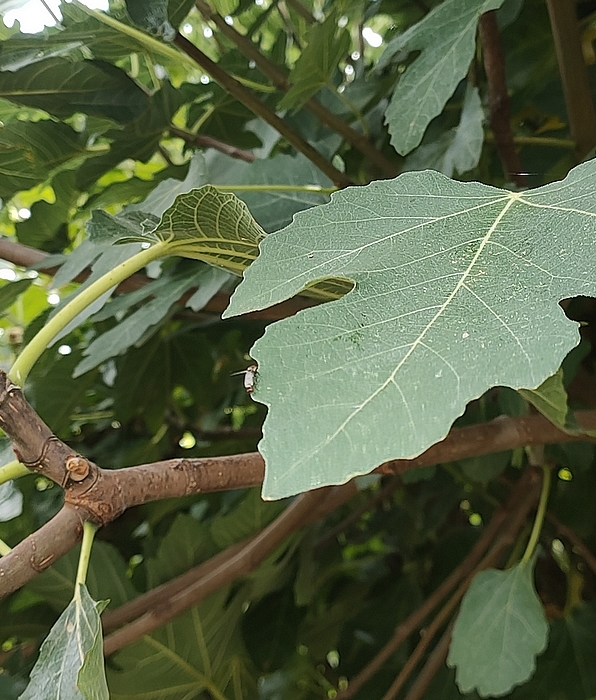
Two black fig flies in copula on a fig tree leaf.
(on the left, on the edge of the leaf central lobe).
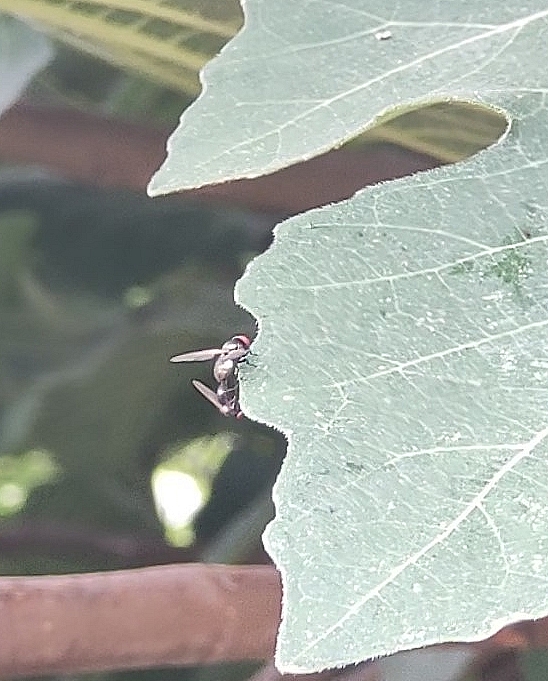
Two black fig flies in copula on the edge of a fig tree leaf.
IN COPULA COUPLE CONFIGURATION
The coupling position was of the "end-to-end" type. The two flies did not overlap but were positioned at the same level in opposite directions, and joined by the tip of their abdomen; one had its wings spread (horizontally held or, more often, raised), while the other had its wings closed.
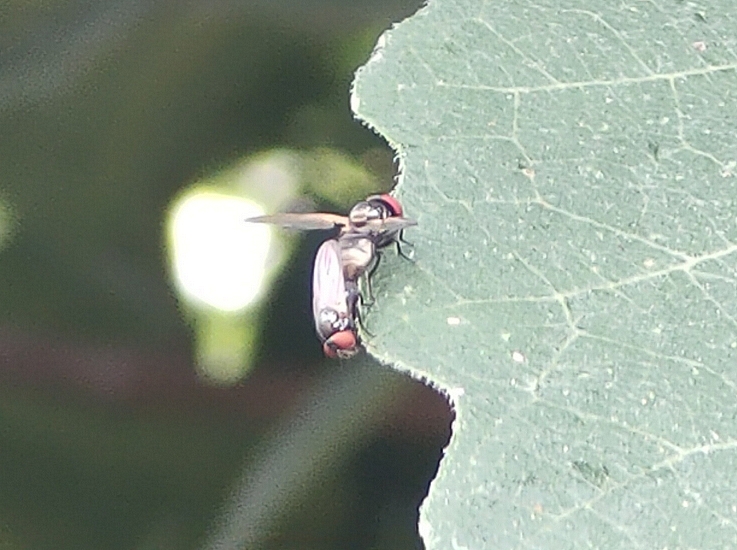
End-to-end mating position of black fig flies feeding on a fig tree leaf edge.
(the two flies are joined by their abdomen tip).
It can be seen that the two mated individuals differ in size. The one with folded wings is noticeably smaller than the one with spread wings. Based on the standards
I have observed for the species, it likely measures 3.5 mm in length (excluding wing overhang), while the other measures 4 mm or slightly more. See the photograph below.
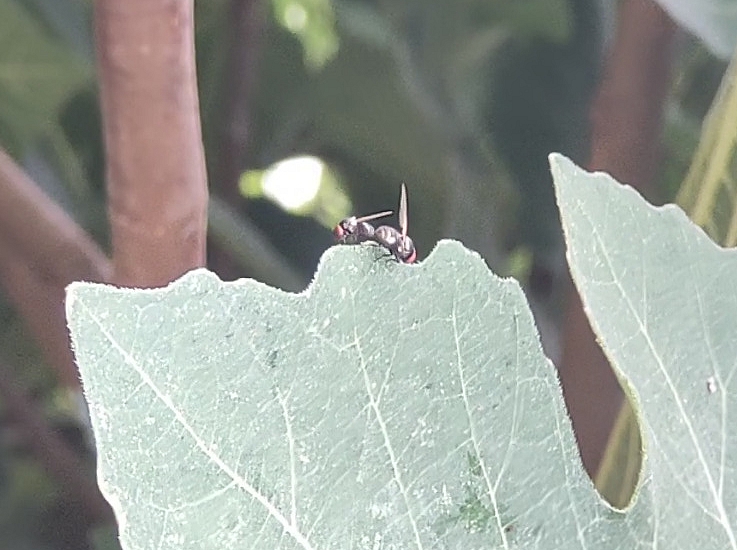
Sillba adipata McAlpine: end-to-end mated individuals differing in size.
(the individual on the left is significantly smaller than the other one).
It is not easy to distinguish the male from the female in the available photographs and in my two videos (abdominal segmentation is not visible due to the lack of close-ups). However, the smaller individual (with folded wings) shows a narrow interocular space, indicating that it is the male. This feature is visible to a trained eye in the third photograph of this chapter and becomes clearer when certain photographs are magnified beyond 100%, even though they then lose some sharpness. The individual with spread wings is therefore the female; she pulls the male along and dictates changes in direction. Note: also to a trained eye, the third photograph of this chapter reveals that the larger individual has a wide interocular space (seen from behind, to the left of the only visible eye), confirming that it is indeed the female.
In an observation of a mated couple made by François DROUET in 2016 (see relevant chapter), the configuration was reversed: the individual with spread wings was clearly the male, though it should be noted that both individuals were roughly the same size. In the couple I observed it is possible that the fact the male was significantly smaller influenced the female's role in taking the lead. It is worth recalling that body size is not a reliable indicator of sex in Silba adipata McAlpine; small individuals (3.5 mm in length) are encountered not infrequently (though representing a minority) among both males and females (see the subchapter relative to the size in the Black Fig Fly general description chapter).
ABDOMENS ARTICULATION
By reviewing my videos, I noticed that at the point where the abdomens join, the female's abdomen is in the upper position (the male's abdomen attaching to it from below). In François DROUET's 2016 observation (see chapter), the abdomens articulation was reversed: the male's abdomen was in the upper position. For the couple I observed, it seems likely that the abdomens articulation is due to the male being significantly smaller than the female.
I also observed that sometimes the two abdomens are no longer strictly pressed together, without copulation ceasing thanks to a connection via an appendage of varying length. Based on my interpretation
after closely examining the photographs, this is the female's ovipositor, extended to varying degrees depending on the positioning requirements (and not the male's aedeagus, which is more or less distended).
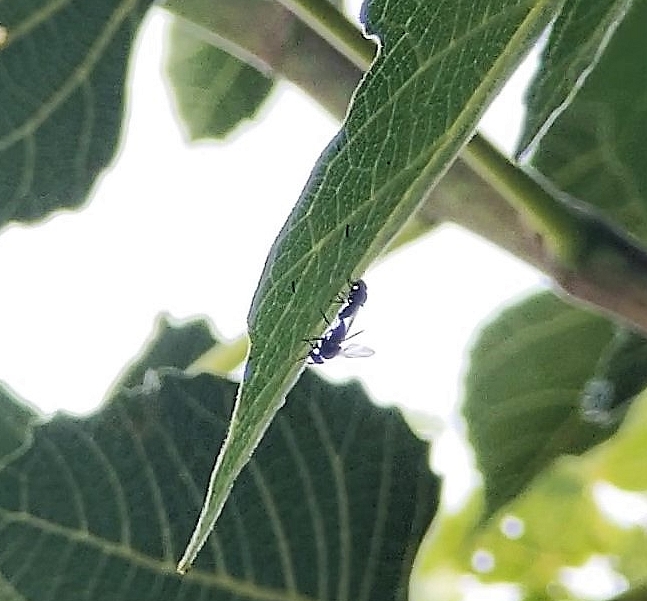
Silba adipata McAlpine in copula on a fig tree leaf underface.
(at certain times, the abdomens are not strictly attached, but their connection is not broken).
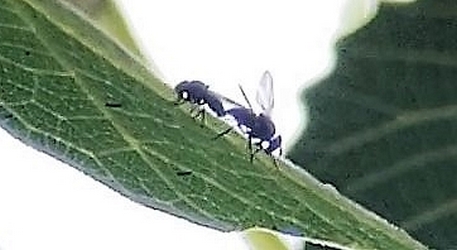
Silba adipata McAlpine in copula on a fig tree leaf underface.
(at certain times, the abdomens are not strictly attached, but their connection is not broken).
COUPLE MOVEMENTS ON THE LEAF UPPER SIDE
I was able to observe the couple for about four minutes. During the first third of their time on the fig tree leaf, it remained on the leaf's edge, barely moving. The two flies carried out their feeding activity, most often keeping their abdomens practically in line with each other, sometimes causing them to show an angle of moderate amplitude. The only significant movement was an attempt by the male to move under the leaf, which was thwarted by the female, who firmly pulled him back up to the top. At the end of this first part of their time on the leaf, the couple moved to the underside. See the video below. Note: at the end of the video, a wing can be seen as the couple completes its passage on the underside of the leaf. The passage itself is not visible due to strong gusts of wind, making this part of the original video unusable.
Silba adipata McAlpine in copula on a fig tree leaf.
COUPLE MOVEMENTS ON THE LEAF UNDERFACE
The couple traversed the leaf underside in two stages: first, moving upwards a few centimeters towards the petiole at moderate speed, then turning completely around and descending quite rapidly along the midrib to the very tip of the central lobe. I noticed that, during the fast-walking portion of the journey, the female seemed to be pulling the male along rather than synchronizing its walk with the backwards one of its partner (I had previously observed unmated individuals of Silba adipata McAlpine walking backward).
The female then toppled over, as if trying to take flight, pulling the male with her. But the male, largely suspended in mid-air, remained clinging to the leaf and the couple did not fly away. The female then righted herself to approach the male, and the two flies formed a V-shape (their joined abdomens showing an acute angle). See video below.
Silba adipata McAlpine in copula on a fig tree leaf underface.
The couple remained (still in copula) at the tip of the leaf; but it did not move along the leaf itself, tough mobile in place. The two flies formed angles ranging from 90° to 45°, sometimes less, with each other.
See the photograph and the video below. This activity lasted about one minute, after which the couple took flight (see the following subchapter).
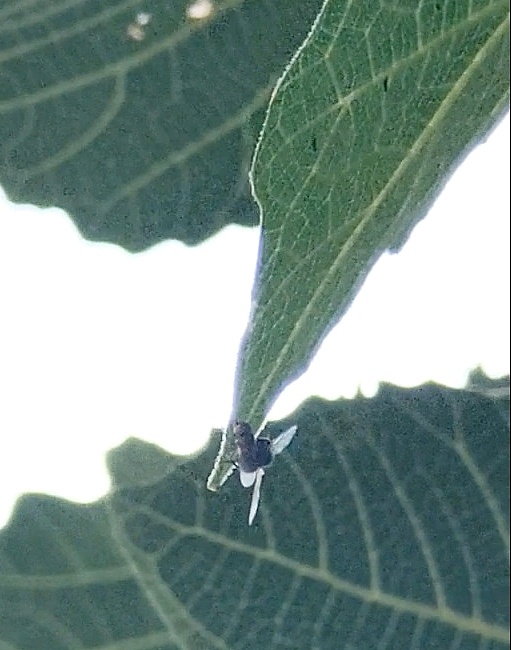
Silba adipata McAlpine in copula at the tip of a fig tree leaf (underface).
(note the 45° angle between the two flies).
Silba adipata McAlpine in copula at the tip of a fig tree leaf (underface).
COUPLE TAKING FLIGHT
The female, initially positioned at a 90° angle to the male, disengaged herself by moving slightly higher up towards the petiole, pulling the male into a position almost aligned with her abdomen. She then lifted herself up and took flight downwards (as is often the case with Silba adipata McAlpine), carrying the male along still attached to her. See video below.
Silba adipata McAlpine in copula taking flight from the underside of a fig tree leaf.
The details of the couple taking flight are not visible when watching the video due to the speed of the flight. However, a frame-by-frame analysis reveals that when the couple leaves the fig tree leaf, the two individuals remain attached. The male keeps his wings folded and his body aligned with that of the female, whose wings are spread (as if he were not intending to fly himself, but simply to remain clinging to the female during the flight).
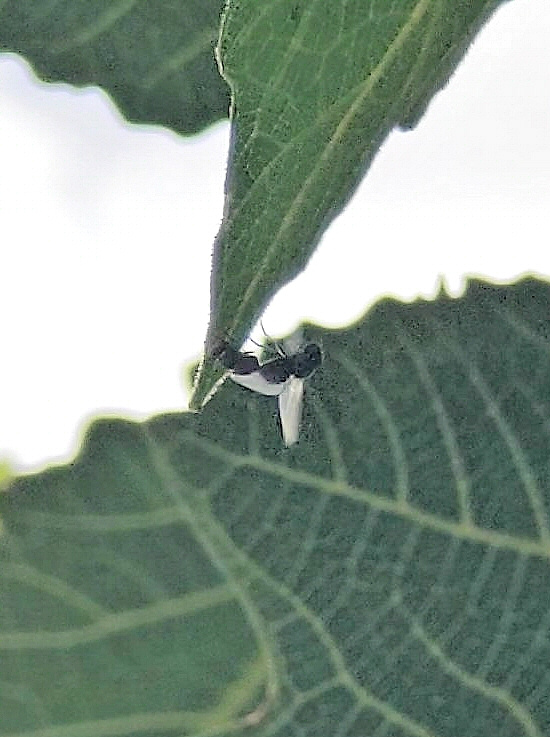
Silba adipata McAlpine in copula: female rising to take flight with the male attached to her.
(it is the ventral side of the male which is visible, slightly folded forward).
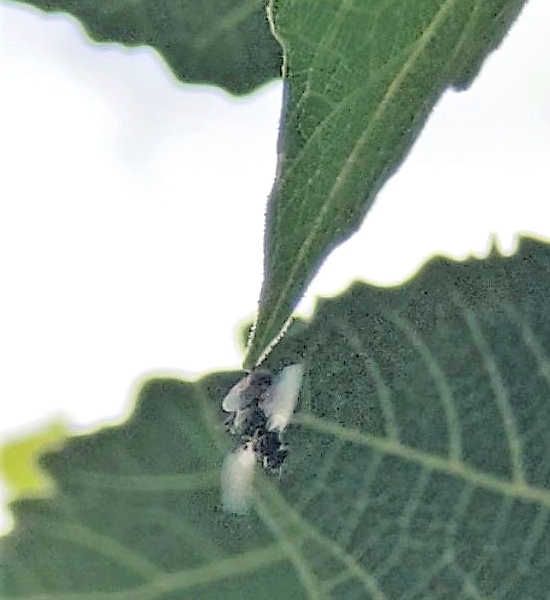
Silba adipata McAlpine in copula: female taking flight and carrying the male attached to her.
(note that the male keeps his wings folded).
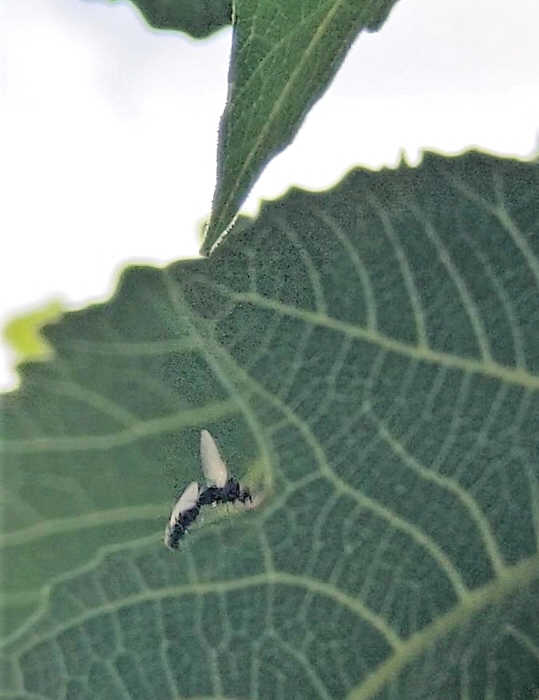
Silba adipata McAlpine in copula: couple immediatly after taking flight.
(note that the male keeps his wings folded).
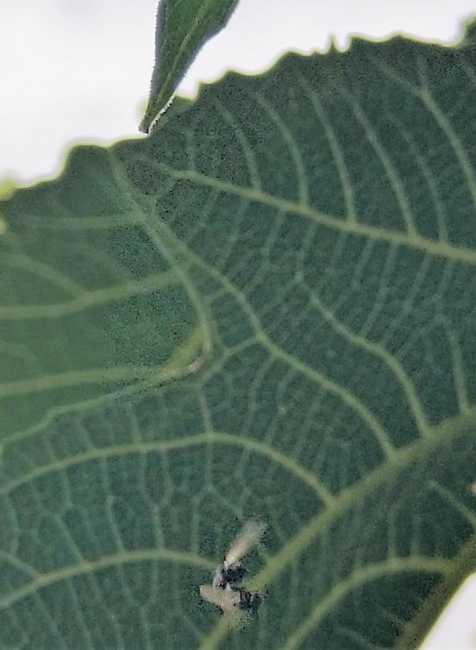
Silba adipata McAlpine in copula: couple falling after taking flight.
(last available image).
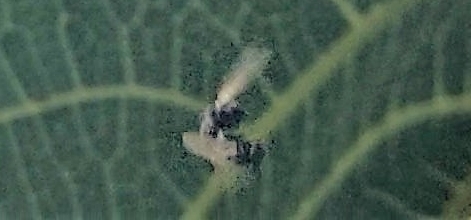
Silba adipata McAlpine in copula: couple falling after taking flight.
(enlargement 100%, less sharp).
Note: the last image obtained through frame-by-frame video analysis, is difficult to interpret. The couple appears either separated (head-to-tail) or joined (male with folded wings; perception of a second female wing crossing the male's wings from above at a 90° angle).
ADDITIONAL OBSERVATION
Given the speed of the female's flight, even while carrying the male, I was unable to observe the couple beyond the moment it took flight. However, I noticed that a Silba adipata McAlpine individual landed on a nearby small leaf immediately after the couple took flight, suggesting a separation. This is also, according to my interpretation, what appears to show the last image of the couple visible via the frame-by-frame video analysis (see previous subchapter).
This individual remained motionless on the leaf for about two minutes. The photographs examination reveals that it is a male (narrow interocular space) and that its abdomen appears very slender when viewed from the side.
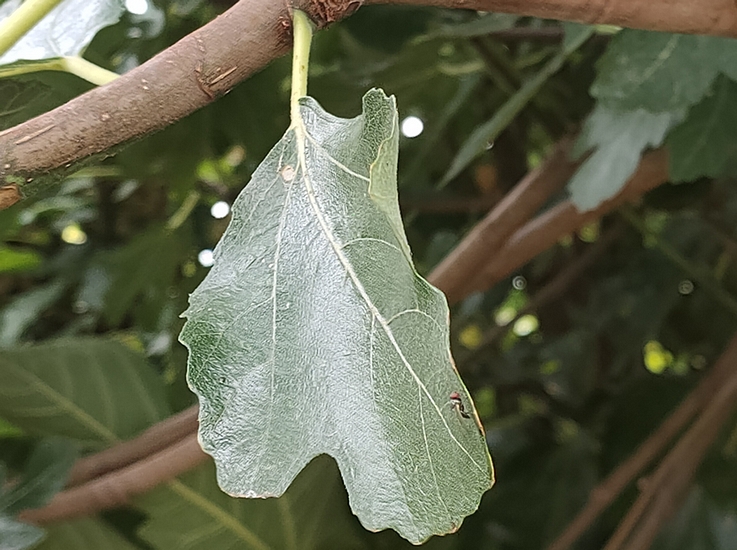
Silba adipata McAlpine individual that landed on a small fig tree leaf after the couple took flight.
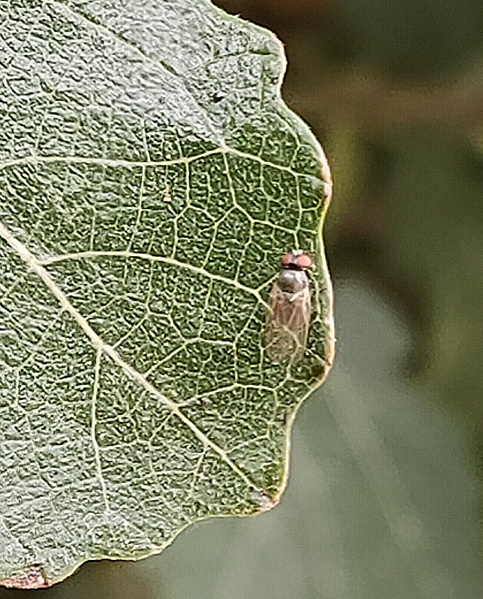
Silba adipata McAlpine individual that landed on a small fig tree leaf after the couple took flight.
(the narrow interocular space indicates that it is a male).
RELATED CONSIDERATIONS
I observed the mated couple in flight before it landed on the fig tree leaf. Thus, observations of mated Silba adipata McAlpine individuals are not limited to those that have already landed.
Furthermore, photographs of the couple in copula taking flight suggest that, when it is flying, only one partner beats its wings, while the other clings to it with its wings folded.
I did not witness the actual act of mating, so the question of where Silba adipata McAlpine mates remains open. However, I agree with the plausible hypothesis of mating in flight proposed at the end of the chapter relating to the observation of a couple by François DROUET in 2016 (having myself participated to the reflection on the arguments that support this hypothesis).
