Presentation Biology Living habits Infestation Control methods
Home > Infestation > Multiple ovipositions in the same fig (Examining the larvae contained in the fig).
Author: François DROUET.
Photographs: François DROUET.
All rights reserved.
Multiple ovipositions in the same fig
(Examining the larvae contained in the fig)
I have highlighted the existence of multiple Black Fig Fly ovipositions in a same fig by three means: examination of the larvae contained in the figs (this chapter), direct observation of the egg-laying females on the fig trees (see chapter), study of the eggs deposited under the ostiolar scales and/or in the ostiolar canal (see chapter).
EXAMINING THE LARVAE CONTAINED IN THE FIG
FIRST CLUE
The first clue to detect multiple ovipositions in a same fig is the presence in it of a number of larvae greater than 5. Indeed, Silba adipata McAlpine lays 1 to 5 eggs during an oviposition in a fig (see chapter). The maximum number of larvae I have found in a fig is 8.
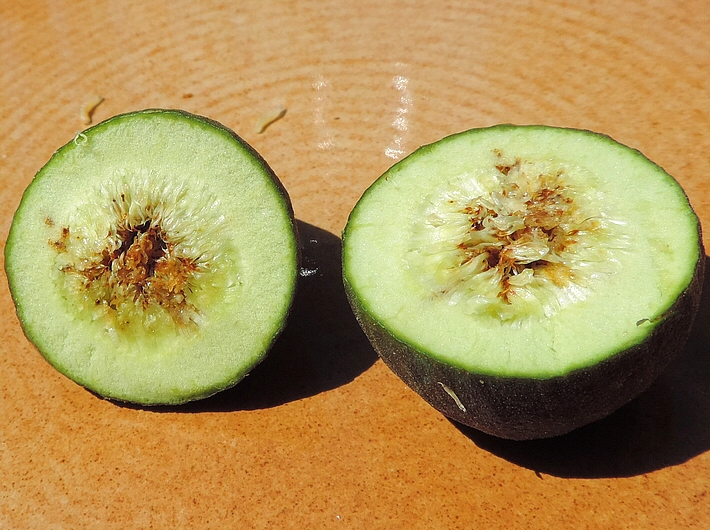
Silba adipata McAlpine: infested immature fig containing 7 larvae.
(breba fig; 'Grise de la Saint-Jean' variety; diameter 2.8 cm; April 25, 2018).

Silba adipata McAlpine: 7 larvae found in a same immature fig.
(note: 5 large larvae, 3 above et 2 below; and 2 smaller larvae, in the center).
SECOND CLUE
Multiple ovipositions in the same fig are detected by comparing the sizes of the larvae it contains. The observation of different larvae sizes indicates that there were successive ovipositions in the fig, several days apart (at least as many times as there are different larvae sizes). In general, the larvae are of two different sizes, but I was able to observe on two occasions in the same fig three different larvae sizes.
This second clue is particularly valid for figs containing 2 to 5 larvae, for which the larvae number does not allow to detect multiple ovipositions.
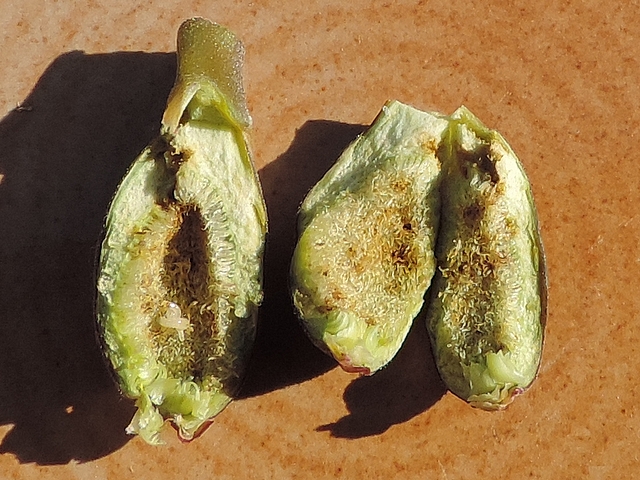
Silba adipata McAlpine: infested unripe fig revealing 4 larvae of 2 different sizes.
(breba fig; 'Grise de la Saint-Jean' variety; diameter 1.2 cm; April 12, 2020).
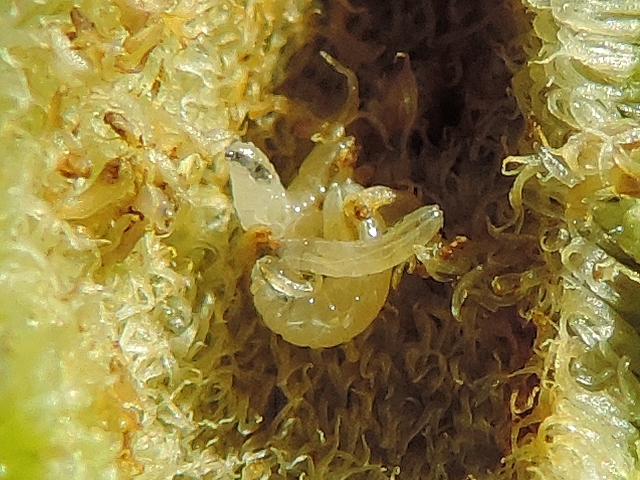
Silba adipata McAlpine: larvae of 2 different sizes in an unripe fig.
(the fourth larva is hidden by the other three; 2 or more ovipositions, several days apart for larvae of different sizes).
Below, three other observations of multiple ovipositions in a fig containing 2 to 5 eggs.
OBSERVATION 1
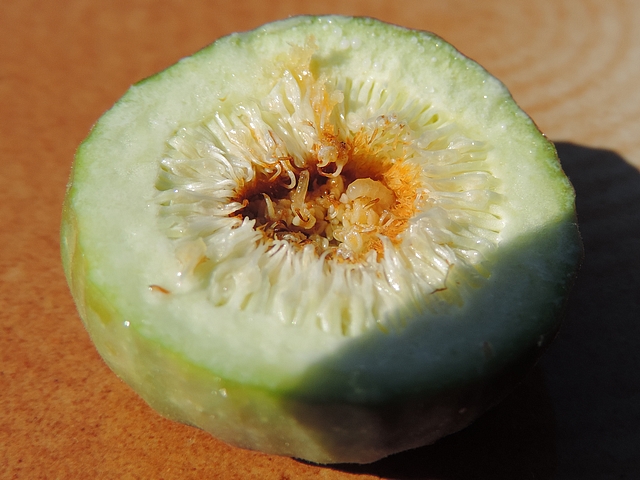
Silba adipata McAlpine: cross section of an unripe infested fig, revealing 2 larvae of different sizes.
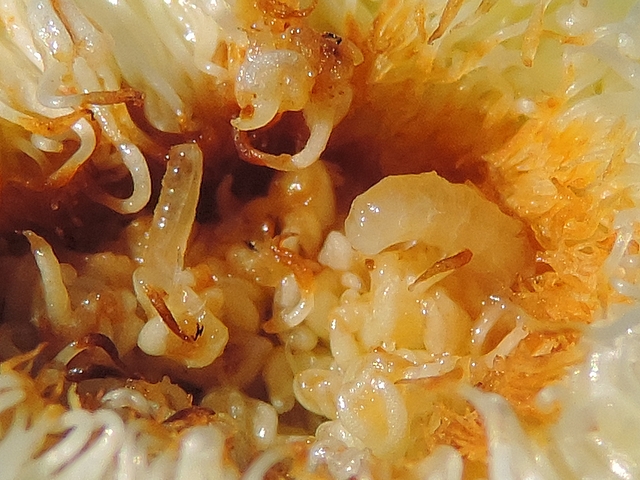
Silba adipata McAlpine: detail of the central cavity of an unripe fig containing 2 larvae of different sizes.
(the larva on the left is much smaller than the one on the right: 2 ovipositions several days apart).
OBSERVATION 2
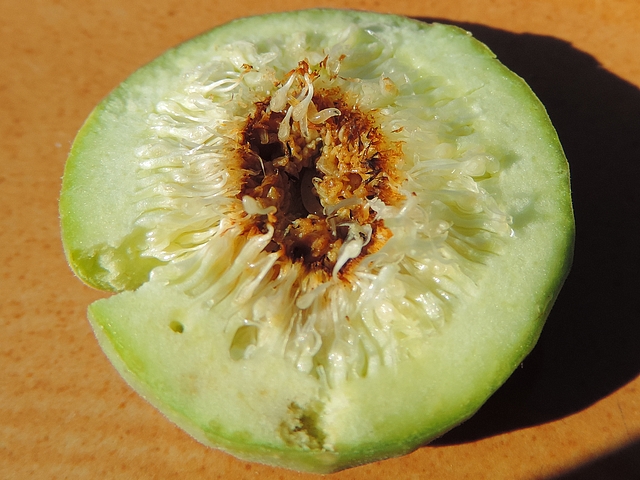
Silba adipata McAlpine: cross section of an unripe infested fig containing 3 larvae of different sizes.
(2 larvae on the top of the inflorescence, and a large larva in the bottom of the central cavity)
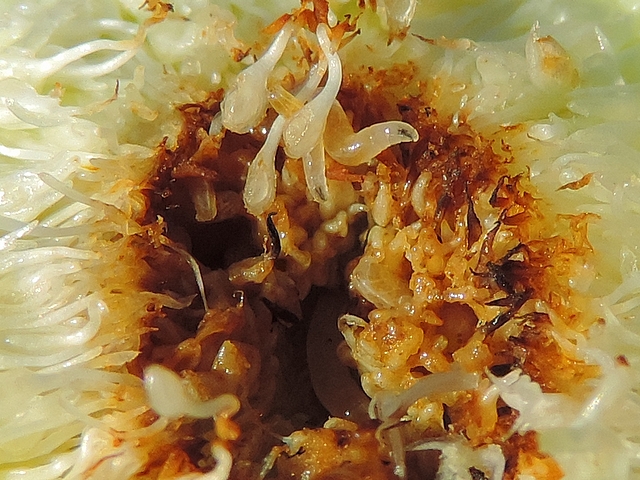
Silba adipata McAlpine: detail of the central cavity of an unripe infested fig revealing 3 larvae of different sizes.
(note the large larva in the bottom of the central cavity; 3 larvae of different sizes reveal 3 ovipositions several days apart).
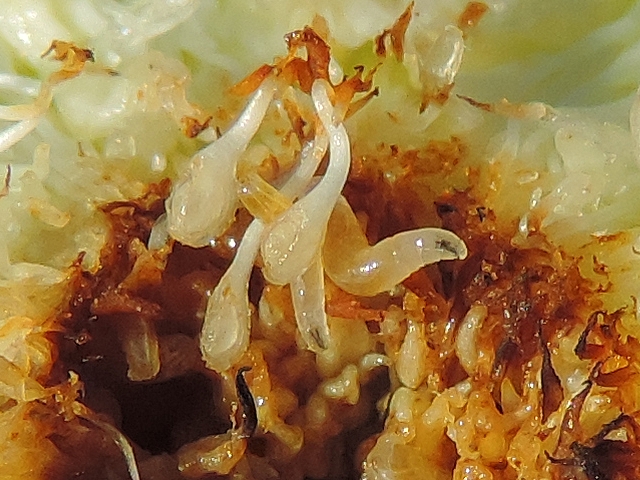
Silba adipata McAlpine: detail of the 2 larvae of different sizes above the inflorescence.
(note the small size of the larvae, comparing it to that of the flowers).
OBSERVATION 3
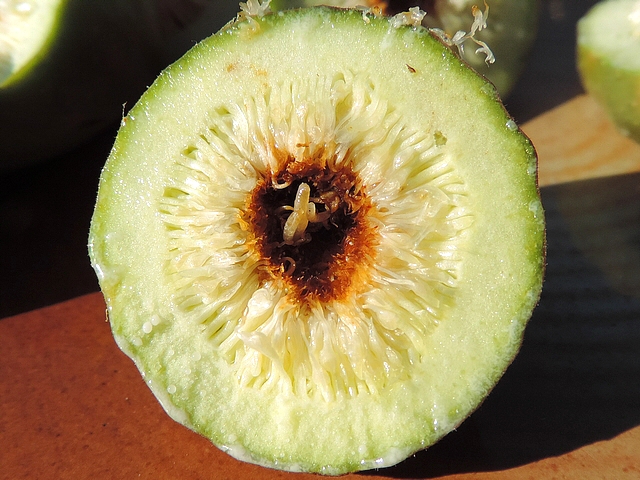
Silba adipata McAlpine: cross section of an unripe infested fig, revealing 3 larvae of different sizes.
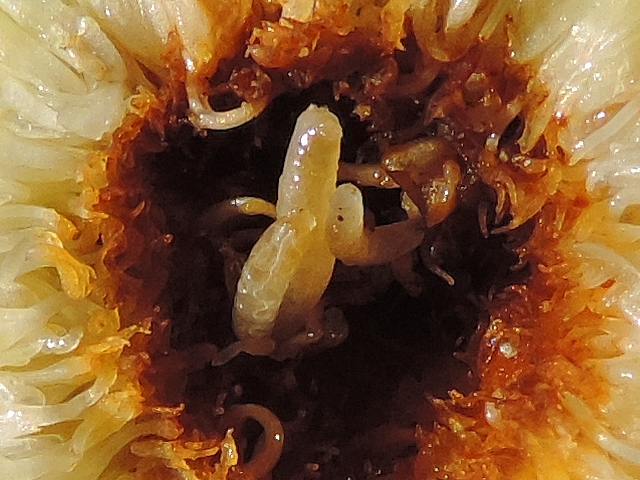
Silba adipata McAlpine: detail of the central cavity of an unripe fig containing 3 larvae of different sizes.
(3 larvae of 3 clearly different sizes: 3 ovipositions sereral days apart).
EVALUATION OF THE TIME BETWEEN MULTIPLE OVIPOSITIONS
The possible difference in size between the larvae contained in the same immature fig is generally clearly perceptible to the naked eye. To know the time between multiple ovipositions in the fig, it is necessary to measure the larvae size. I measure the larvae on the graduated part of a caliper, blocking the end of the abdomen with dissecting forceps at the level of a millimeter mark and observing the length of the larva with a magnifying glass (with an outstretched body).
The following observation was made in July 2019 on an immature fig of the uniferous variety 'Bellone': the fig contained 6 larvae, which had two distinctly different sizes (3 larvae for each of the two sizes).
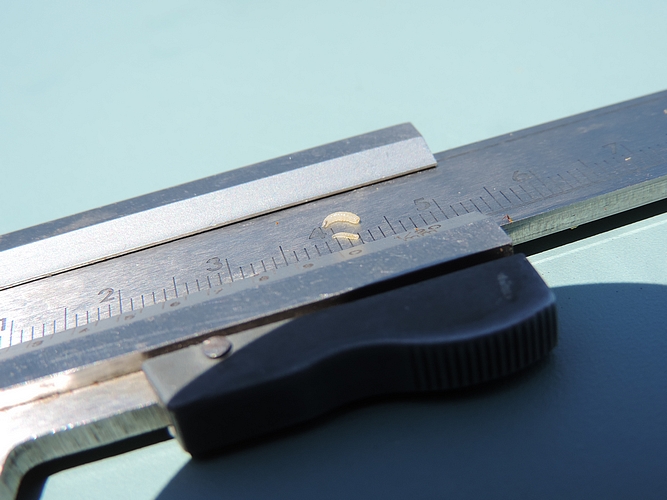
Silba adipata McAlpine: size measurement of 2 of the 6 larvae found in the same immature fig.
(each being a specimen taken from 3 larvae of the same size).
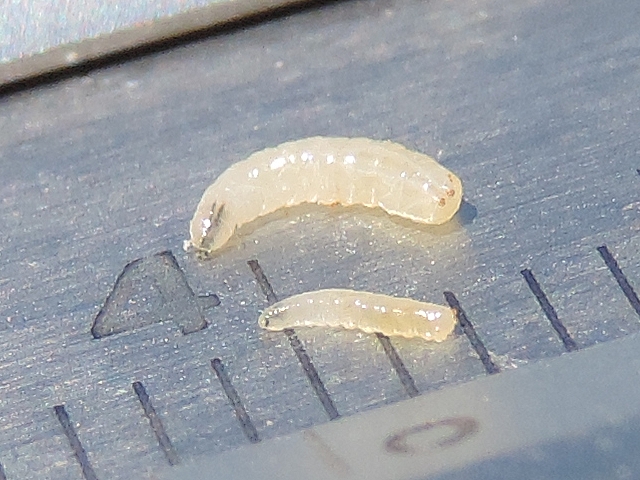
Silba adipata McAlpine: size measurement of 2 of the 6 larvae found in the same immature fig.
(each being a specimen taken from 3 larvae of the same size).
For the above observation, the length measured for the stretched body was almost 3 mm for the smallest larva, and 5 mm for the other larva. Taking into account the fact that the observation took place in July, the egg incubation period lasts 3 days, and the larva growth rate is 1 mm per day. The larva length being at birth slightly less than 1 mm, we can conclude: the smallest larva is 2 days old and oviposition dates back to 5 days; the other larva is 4 days old and oviposition dates back to 7 days. The ovipositions are therefore spaced 2 days apart.
Considering that the larvae contained in the fig are divided into two times three in two different sizes, it can be concluded that two egg laying females visited the fig, each laying 3 eggs in the fig. With all rigor, we cannot exclude that females laid less than three eggs (i.e. one or two) during their visit to the fig, and were therefore in greater numbers. It being understood that in any case, it is impossible to know if these are different females, or if one or more females have returned to visit the fig from one day to another, or even on the same day.
 Top of page Summary