|
Presentation Biology Living habits Infestation Control methods |
||
|
|
||
|
|
|
Author: François DROUET. |
|
|
||
|
The egg maturation (duration, eggs number per female)
The description of the egg of Silba adipata McAlpine, accompanied by observations of unhatched eggs and empty eggs envelopes (chorions), is the subject of a specific chapter. Another chapter deals with the maturation and incubation of the egg, including the presentation of the female reproductive organs. I provide below information and observations about the egg maturation duration and the eggs number per female. According to the following plan: egg maturation duration, number of eggs carried by a mature female.
EGG MATURATION DURATION
OBSERVATIONS OF F. SILVESTRI According to the observations of Filippo SILVESTRI, in the summer period and for individuals fed with water and honey, the maturation of the Black Fig Fly's egg takes place in about ten days. Reference: SILVESTRI F., 1917, Sulla Lonchaea aristella Beck. (Diptera : Lonchaeidae) dannosa alle infiorescenze e fruttescenze del caprifico e del fico, Bollettino del Laboratorio di Zoologia Agraria in Portici, vol.12, pp. 123 -146. The fact that the author specifies that the eggs maturation duration is that observed for individuals under a water + honey diet assures us that it comes from dissections of flies raised in laboratory conditions, and not from a simple estimate drawn from his general knowledge of Diptera. But F. SILVESTRI provides neither details on the operating mode, nor information on the number of dissected females and on the tested ages of sacrifice.
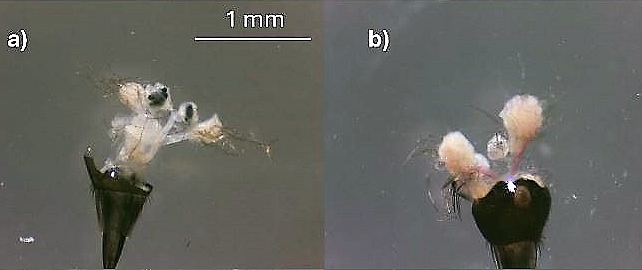
OBSERVATIONS OF DIAZ-DEL-CASTILLO R. ET AL. In 2025, DIAZ-DEL-CASTILLO R. et al. published an article in the journal Insects concerning the sexual development of Silba adipata McAlpine. Reference: DIAZ-DEL-CASTILLO R., CÓRDOVA-GARCIA G., PÉREZ-STAPLES D., BIRKE A., WILLIAMS T., LASA R., 2025, Sexual Development of Silba adipata (Diptera: Lonchaeidae): Effects of Diet, Ultraviolet Light and Fig Latex, Insects 16, no. 5: 495. The authors studied the maturation duration of Silba adipata McAlpine eggs under four different diets: refined sugar; refined sugar + fig latex; refined sugar + hydrolyzed proteins; and refined sugar + hydrolyzed proteins + fig latex. Water was available ad libitum in all four diets. Experimental conditions: temperature 24 °C (+ or - 1 °C), relative humidity 65% (+ or - 10%), groups of 10 to 15 females in rearing cages (23.5 x 13.5 x 13.5 cm). For each diet, 8 to 15 females were randomly selected from eight different cages 3, 6, 9, 15, 21, and 27 days after the start of the experiment. The flies were sacrificed at −20 °C and then dissected in physiological saline.The authors specify that immature oocytes appear as small spheres, giving the ovary a lobular appearance, while mature oocytes are much larger and spindle-shaped. They considered a female to be mature if it had at least two large oocytes (length > 800 μm) in the ovary. For diets based on sugar alone or sugar plus fig latex, no female flies developed mature oocytes during the 27 days of the experiment. See below for photographs of immature female ovaries (reproduction authorized, article under Open Access license).
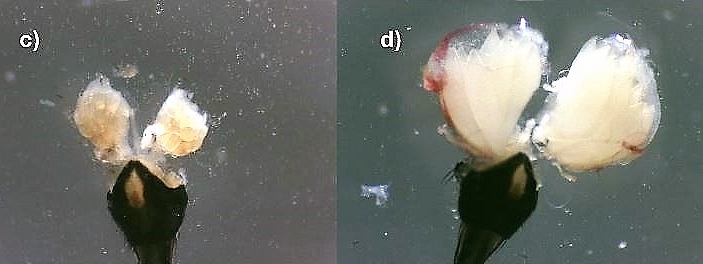
Silba adipata McAlpine: ovaries of immature females. For both diets containing hydrolyzed proteins (combined with sugar or sugar + fig latex), mature females were found only from 15 days of age. In the groups of females sacrificed at 3, 6, and 9 days of age, no mature females were found. For the sugar + hydrolyzed proteins diet, the percentage of mature females found in the group of females sacrificed at 15 days of age was 8%. For the sugar + hydrolyzed proteins + fig latex diet, this percentage was 20%. See photographs below (reproduction authorized, article under Open Access license).
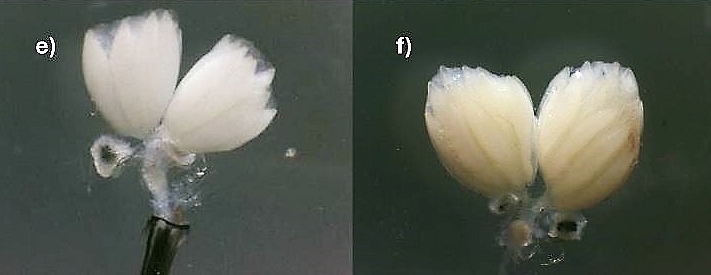
Silba adipata McAlpine: ovaries at 15 days of age. For the sugar + hydrolyzed proteins diet, the percentage of mature females found in the group of females sacrificed at 21 days of age was 44%. And the percentage of mature females found in the group of females sacrificed at 27 days of age was 33%. For the sugar + hydrolyzed proteins+ fig latex diet, the percentage of mature females among the females sacrificed at 21 days of age was 46%. And the percentage of mature females among the females sacrificed at 27 days of age was 56%. See photographs below (reproduction authorized, article under Open Access license).
Silba adipata McAlpine: ovaries of mature females. DIAZ-DEL-CASTILLO R. et al. indicate that their observations of females on four different diets allow the conclusion that eggs maturation does not occur if the female does not consume proteins. They conducted two further experiments (impact of access to ripe figs cut in half and impact of exposure to UV-A), carried out with the only diet sugar + hydrolyzed proteins, and with sacrifice ages of 6, 9, 15, and 21 days. They concluded that neither of these factors had any effect on eggs maturation. It should be noted that in both experiments, no mature females were found in the groups of females sacrificed before 15 days of age (in the groups of females sacrificed at 6 and 9 days of age, no mature females were found).
HETEROGENEITY OR INCONSISTENCY IN PERCENTAGES OF MATURE FEMALES The authors report having observed across the various experiments a significant variation in the percentage of mature females found in the groups of females sacrificed at a given age. Table 1 of the article provides details of the groups of sacrificed females, by experiment and by age at the time of sacrifice (including the number of females in each group). For example, we can see in Table 1 the following variations (but also inconsistencies). Variations under identical conditions: for the sugar + hydrolyzed proteins diet, the percentages of mature females among the groups of females sacrificed at 15 days of age are as follows: 8% (baseline diet test, group of 13 females); 12.5% (UV-A incidence test – case of non-exposure to UV-A, group of 8 females); 40% (incidence of access to ripe figs test – case without access to figs, group of 10 females). Inconsistencies: for the same diet (baseline test), the percentage of mature females found in the group of 12 females sacrificed at 27 days of age (33%) is lower than that observed for the group of 9 females sacrificed at 21 days of age (44%). Also for this diet (incidence of access to ripe figs test – case without access to figs), the percentage of mature females found in the group of 10 females sacrificed at 21 days of age is 0%, whereas it is 40% for the group of 10 females sacrificed at 15 days of age. The authors explain this (and I agree) by the fact that the samples are small, as the availability of female flies for the experiments was dependent on the emergence of imagos from figs collected in the orchards. They indicate that the observed percentages provide only a first estimate of the Silba adipata McAlpine sexual development.
LOW PROPORTION OF MATURE FEMALES DIAZ-DEL-CASTILLO R. et al. state that, across all experiments, 40% of females sacrificed at 15 days old were mature, and this was the case for 56% of those sacrificed at 21 days old. According to them, these relatively low proportions of mature females suggest the existence of additional specific stimuli not taken into account in their studies, which could play an essential role in facilitating sexual maturation. For my part, I can compare these low proportions of mature females at 15 and 21 days of age to what I observed during my 2025 campaign to capture Silba adipata McAlpine individuals on my 'Bellone' fig tree: out of 178 females captured with a mouth aspirator, I found only 25 mature females, or 14%. It should be noted that the captures campaign period, i.e., from the last days of May to the end of June, amply covers the Silba adipata McAlpine intense attacks phase (phase 1 of the attack pattern), which lasts 15 days at the beginning of June for the 'Bellone' fig tree. The low proportion of mature females (14%; 25 individuals) is not inconsistent with the very high rate of Silba adipata McAlpine attacks that I observe from year to year on the 'Bellone' fig tree (95% crop loss), if we recall that the average daily flow of egg-laying females is estimated at 3 on this fig tree during the Silba adipata McAlpine intense attacks phase (see chapter). The 25 captured mature females represent a potential flow of egg-laying females for 8 days, during the 15-day period of Silba adipata McAlpine intense attacks on the 'Bellone' fig tree. It should be noted that these mature females were captured with a mouth aspirator at latex oozing points created on the fig tree, while they were not in the act of laying eggs (because, according to my observations, a Silba adipata McAlpine female performing her egg-laying sequence on a fig tree never interrupts this sequence to feed; see chapter). Thus, observations of a small proportion of mature females, conducted in the laboratory by Diaz-del-Castillo R. et al. and in the field by myself, might reveal an absence of fecundity for at least the first month of life (perhaps for their entire lifespan?) for an important part of a given Silba adipata McAlpine generation. The damage caused to fig crops by a population of Silba adipata McAlpine individuals would then be lower than previously thought. This bold hypothesis is fragile. We must consider the reasons that could explain the lack of fecundity. It is also important to situate the hypothesis within the context of the three-phase attack pattern observed for Silba adipata McAlpine. Finally, we need to devise other methods for determining the percentages of mature females in order to compare their results with those of the two methods mentioned above. The first method that comes to mind is examining the abdomen of all females captured in McPhail traps baited with a liquid food attractant (during the Silba adipata McAlpine intense attacks phase). However, the principle would be the same as that of captures with a mouth aspirator (i.e., capturing females attracted by food bait), and the results are likely to be identical. Another method would involve marking with a specific color 100 female imagos emerging from infested breba figs of a given biferous fig tree, releasing them onto that tree and then capturing the marked females that return to the tree. Captures should only be made after a 15-day waiting period following the release date for females engaged in feeding activities, and without this waiting period for egg-laying females. However, this method is very cumbersome to implement and the return rate of marked females to the chosen fig tree may be uncertain.
CONTRADICTIONS BETWEEN THE OBSERVATIONS OF DIAZ-DEL-CASTILLO R. ET AL. AND THOSE OF F. SILVESTRI DIAZ-DEL-CASTILLO R. et al. emphasize that their observations lead to the conclusion that eggs maturation does not occur if the female does not consume proteins. While F. SILVESTRI observed eggs maturation with a low proteins intake (water + honey diet, honey containing less than 1% proteins). Concerning the eggs maturation duration, I note that the difference is not really significant: around 10 days (i.e., 9 to 11) for F. SILVESTRI, 10 to 15 days for DIAZ-DEL-CASTILLO R. et al. (no mature females found for the sacrifice age of 9 days and, for the next sacrifice age tested, 15 days, presence of mature females). The contradiction between the results relating to eggs maturation actually comes from the proportion of mature females found. A low proportion for DIAZ-DEL-CASTILLO R. et al. (40% for the sacrifice age of 15 days, all experiments combined), while F. SILVESTRI, without explicitly assuring us that he observed eggs maturation in 100% of females, does no report to us that he noticed an unexpectedly low proportion of mature females. However, the two experiments were carried out in laboratory conditions. But the fact that F. SILVESTRI provides neither details on the operating mode, nor information on the number of dissected females and on the tested ages of sacrifice, does not allow us to try to explain the discrepancies in results.
NUMBER OF EGGS CARRIED BY A MATURE FEMALE
2021 OBSERVATION On June 5, 2021, as I walked around a fig tree to try to spot ongoing Silba adipata McAlpine ovipositions, I managed to crush an individual of the species with a sharp flick against a torn off petiole base on which it was standing motionless, absorbed in its latex consumption task.
Silba adipata McAlpine: female crushed by a sharp flick against a torn off petiole base. It was a female and, under the impact of the finger, a compact mass of eggs, that I recognized as an ovary, was extracted from the abdomen which split open.
Silba adipata McAlpine: mass of eggs (ovary) extracted from the abdomen of a female crushed by a sharp flick. The photograph below reveals a low number of eggs per ovary, which is however impossible to determine precisely (in the order of 10 to 15, i.e., 20 to 30 eggs per female?).
Silba adipata McAlpine: mass of eggs (ovary) extracted from the abdomen of a female crushed by a sharp flick.
2025 OBSERVATIONS In 2025, I conducted a captures campaign for Silba adipata McAlpine individuals, covering the last days of May and the entire month of June. The primary objective was to study the population dynamics of mature females visiting my 'Bellone' fig tree during this period. It should be noted that the period of Silba adipata McAlpine intense attacks on this fig tree occurs from the beginning of the second week to the end of the third week of June (duration: 2 weeks). Another objective was to count the eggs carried by the mature females. Captures methods: 2- to 3-hour sessions (late afternoon), positioned near latex oozing points created on the fig tree, using a mouth aspirator. Captures: 234 individuals, including 178 females (the abdomens of which were opened and examined under a stereomicroscope). Of these, 25 had clearly visible eggs, but only 7 had eggs sufficiently chorioned to be counted without bursting during handling. The eggs count from these 7 mature females, all 4 mm long, yielded the following results: 21 eggs (May 31); 24 (June 4); 24 (June 8); 28 (second female, June 8); 28 (third female, June 8); 22 (June 10); 29 (June 12). I can also mention the following results: 28 eggs (June 23); 22 (July 7); 24 (second female, July 7) - after dissection of 3 mature females, 4 mm long, sent by Bernard PEYRE, consultant and trainer for the fig industry. In summary, the 10 mature females carried between 21 and 29 chorioned eggs. The two odd counts (21 and 29) could be adjusted to 20 or 22 and 28 or 30 respectively, due to a possible counting error (given the same number of ovarioles for each of the two ovaries). It should be noted that counting eggs is a difficult operation. Some are crushed or fragmented during handling to separate them from the eggs groups extracted from the abdomen. Furthermore, depending on the female, the chorion may not yet be fully developed for some eggs which burst when attempts are made to move them. Finally, the lightness of the eggs and the difficulty in fixing small egg clusters to the slide placed under the stereomicroscope facilitate the ejection from the work area (and loss) of small groups of eggs. In these groups, only an approximate eggs number (2 or 3, or 2 to 4) has been identified before attempting to identify individual eggs. Consequently, the count performed should most often be considered an estimate that may be subject to a margin of error. Future counts involving a larger number of mature females and the progressive refinement of our eggs handling techniques will allow us to determine more precisely the number of eggs carried by a mature female (and any variations in this number among certain females). In any case, the already obtained results provide a fairly significant order of magnitude.
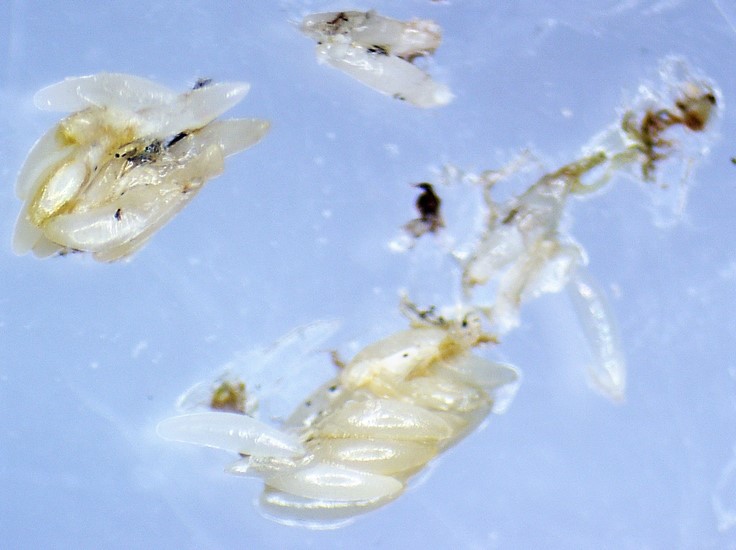
Below: photographs of the opened abdomen of a mature female, the ovaries freed from the sclerites, as well as their fragmentation for the purpose of the eggs individualization and counting.
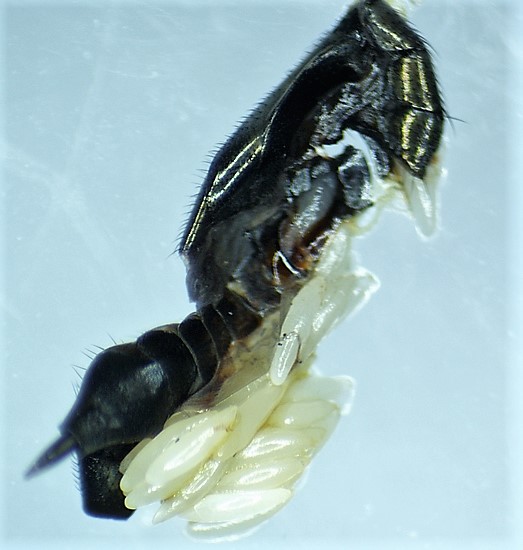
Silba adipata McAlpine: exposed ovaries of a mature female (isolated abdomen).
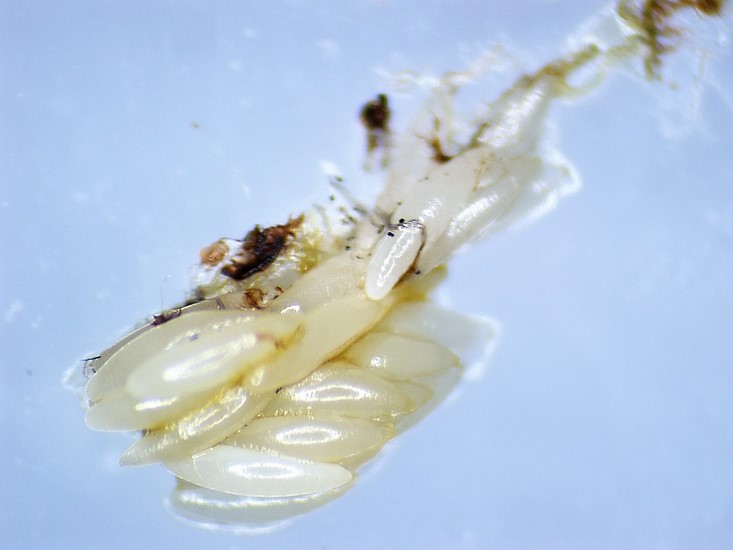
Silba adipata McAlpine: ovaries of a mature female freed from the sclerites.
Silba adipata McAlpine: counting of well chorioned eggs of a mature female.
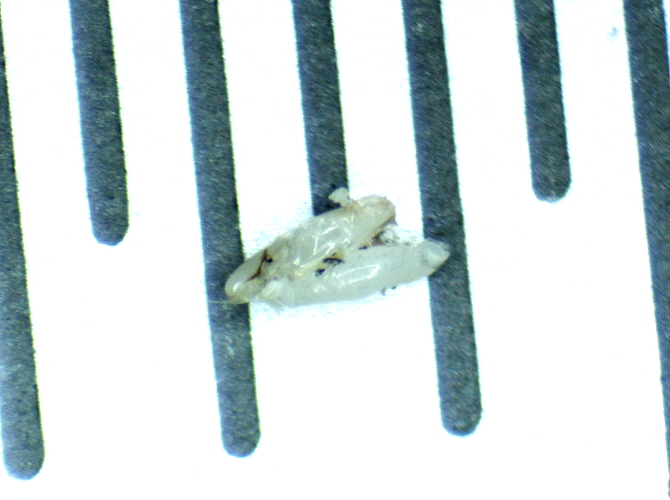
Silba adipata McAlpine: two eggs of laying size extracted from the abdomen of a mature female.
OBSERVATIONS OF DIAZ-DEL-CASTILLO R. ET AL. In the 2025 article we cited above for the egg maturation duration, DIAZ-DEL-CASTILLO R. et al. report having dissected mature Silba adipata McAlpine females and found that they carried 20 to 24 eggs, i.e., 10 to 12 per ovary. The eggs count appears to have been performed on a small number of females (8). These were laboratory-reared females, obtained from infested figs collected from commercial orchards. Reference recall: DIAZ-DEL-CASTILLO R., CÓRDOVA-GARCIA G., PÉREZ-STAPLES D., BIRKE A., WILLIAMS T., LASA R., 2025, Sexual Development of Silba adipata (Diptera: Lonchaeidae): Effects of Diet, Ultraviolet Light and Fig Latex, Insects 16, no. 5: 495.
NOTES FLETCHER in 1987, and CHOU et al. in 2012, have shown on species of the family Tephritidae that eggs development in ovarioles is asynchronous. Reference 1: FLETCHER B. S., 1987, The biology of Dacine fruit flies, Annual Review of Entomology 32, 115-144. Reference 2: CHOU M-Y, MAU R. F. L., JANG E. B., VARGAS R. I., PINERO J. C., 2012, Morphological features of the ovaries during oogenesis of the Oriental Fruit Fly, Bactrocera dorsalis, in relation to the physiological state, The Journal of Insect Science 12, 1-12. It is likely that the same is true for Silba adipata McAlpine, although the latter belongs to a different family (Lonchaeidae). But we were unable to verify this, as counting the eggs was so difficult. Moreover, G. P. FITT has shown the existence of a clear positive correlation between the number of ovarioles per ovary of females of Bactrocera (Dacus) tryoni Froggatt and Bactrocera jarvisi Tryon and their size (measured using the wings length). Reference: FITT G. P, 1990, Comparative fecundity, clutch size, ovariole number and egg size of Dacus tryoni, D. jarvisi, and their relationship to body size, Entomologia Experimentalis et Applicata 55, 11-21. It is not possible to determine whether the fluctuations in the eggs number from one female to another observed during the 2025 Silba adipata McAlpine individuals captures campaign reflect the aforementioned margin of error, or whether they are the result of possible differences in the ovarioles number. It should be noted that the 10 mature females were all the same size (4 mm).
|
||